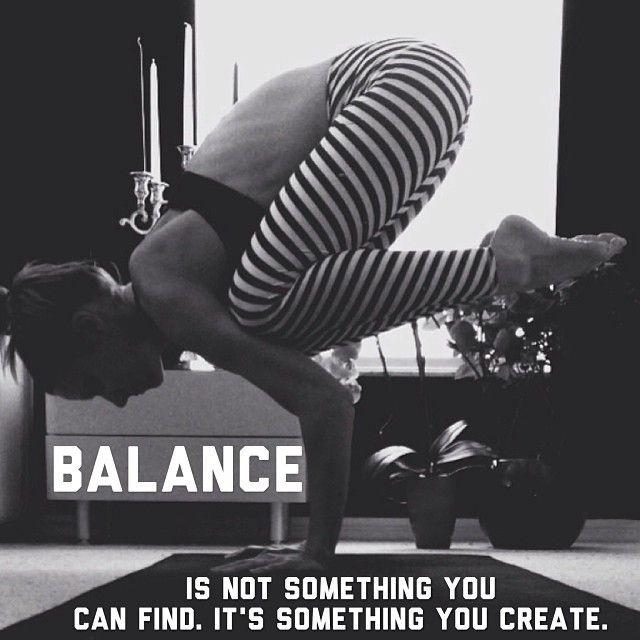
“Balance is Not Something You Find -It’s Something You Create” Jana Kingsford

balance-is-not-something-you-can-find-its-something-you-create-quote-1

Take a moment and think about the things in your life that may need to be balanced.  Your first instinct may be to say your checkbook or your work and social lives.  And that’s an okay place to start.

Look around yourself.  Now ask yourself “Why are people not reaching where they want to be in life?”  It’s simply because things are out of sync…and they need balancing.

When I was given this lesson, so many things just clicked in my head between this and cultivating my own happiness.  They are somewhat relative and this one made me look at specific areas and things that I could be doing wrong or that I could definitely make improvements upon.

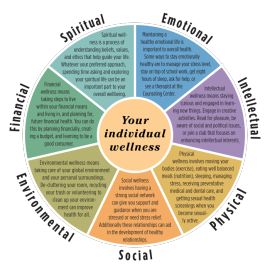
I looked it up and this was the closest thing I could find to the Life Balance Wheel that I want to look at.  There are several different ones out there that throw in a few extra things here and there, or even leave out elements that this one has.  I prefer this one, so this is the one I’m going to use when talking about creating balance in my life.

Life Balance Wheel
3e639ca8b1a0a2d23b148e90fb0f93e9

Don’t kill your eyes trying to read whatever that is scribbled in the colored areas.  The main things I want to look at are those big words around the edge of the circle.

You may be looking at this thing and wondering what on Earth it is or what it means.  Don’t worry..I’m going to break it down as it applies to me.

Environmental-enjoying the surroundings in which you live. What
you come home to has an important effect on how you feel day to day. If you’ve got
lots of unfinished jobs around the house or you’re not happy with where or how you
live, look at what you could do to change it. Pick one outstanding task and aim to do
it by the end of the week. (http://clareevans.co.uk/life-balance-wheel/)

Did you know that the environment that you spend most of your time in can alter your mood or add extra anxiety to your already full plate?  I had never even thought of this before.  And this is where I got my decluttering blog topic from.  Your environment may include people, where you live, clutter, etc..if something is out of whack, you’re going to feel it.

As I looked around my house, I saw nothing but things that needed to be done and clutter.  And then I made up my mind that it was time to get rid of everything that I don’t need or don’t want.  Or even clothes I wish still fit me.  Every day that I’ve done this, I’ve felt so good and like I’m being cleansed.  It’s really hard to explain.  I have trouble doing this at times because when I was younger, we had things…but, it wasn’t a lot.  So, when I got older and decided I could earn whatever I wanted, I didn’t want to let go of ANYTHING.  So, this has been EXTREMELY good for me.

I have to remind myself that if my environment is not conducive, I will not feel well.  So what I/we need is a good, healthy and therapeutic environment.  Whatever that means to you.  For me it’s new paint and a lot of extra clutter GONE!

Intellectual (not be confused with IQ) – get to know yourself better. What steps could you take this year to increase your own personal development? What behaviour would you like to change? Is there something that you’d like to learn to do better? (http://clareevans.co.uk/life-balance-wheel/)

This is the one that I enjoy working on the most.  Though, I tend to get carried away with it at times and then neglect other areas that need balancing.

By expanding our creativity, our knowledge and our skills; I/we can help to refresh our emotional selves.

Often times, once we finish schooling or Education, we stop thinking about growing as if there were a cap on that.  There isn’t!  We have the ability to learn as if we were sponges and to take in so much more.  Get out there and take classes on something new!  There are community activities available in most areas, especially larger communities.  Places like Hobby Lobby, Lowe’s, Home Depot, Michael’s and even the Public Library all off classes or resources on how you can get involved.

For me, I love the arts.  I go out to the theater from time to time to see plays, I’ve been to see the Community Orchestra, I work on paintings and crafts and I write.  All of these things are using my creative mind and help to make me feel good.

Physicalbeing fit, healthy and well. Are you a healthy weight for your height?  How physically active are you – do you take regular exercise? Do you have a healthy diet – limited intake of sugar, caffeine, alcohol and processed food? When was the last time you visited the dentist, got your eyes tested, checked your blood pressure? (http://clareevans.co.uk/life-balance-wheel/)

Sure the above things from the cited website are important, but there are other things that fit into this category as well.  It’s basically recognizing our need for nutrition or diet, sleep, and exercise.  If any of these things become imbalanced, you’re working against Mother Nature and it isn’t going to bode well in the end.

With my anxiety, I actually have trouble sleeping.  A lot of trouble.  Even if I go to bed early, I wake up multiple times throughout the night after only two to three hours of sleep.  The next day, I feel like complete shit.  I’m on medications to help with the amount of rest I should be getting – but at the moment, they don’t seem to be working.  And I like to walk because it’s a natural form of stress relief for me.  Feeling the breeze, the ground and taking in everything around me.  Unfortunately, all Seasons and weather don’t permit me to do this during certain times.  And at night, it just isn’t an option.

Career/Occupation– enjoying your work. Is your job enjoyable and fulfilling? Do you have a plan in place to improve your career/business prospects, gain promotion or plan your retirement? How are your working relationships with your boss, colleagues and others around you? Get to know what makes them tick – after all they’re people too. (http://clareevans.co.uk/life-balance-wheel/)

The above website cited this strictly from a Business standpoint.  However, this could be something that you do on your own or even volunteer work, as well.  Balance comes with how much satisfaction is derived from what you are doing.

For me, inactivity leads to depression.  It’s best that I kind of stay busy, but not get too carried away to the point where I don’t know if I’m coming or going anymore.  I have to make time to rest, too.  It’s all part of the balancing act, isn’t it?

Toxic co-workers and work environments also can lead us to be miserable.  In order to avoid this, set your personal boundaries from the get-go and learn how to say “no” more often.  There were many jobs that I had when I was younger, where I didn’t know how to say “no”, and to be honest I’m still learning how, but I suffered from severe burnout and often got taken advantage of because of it.  Don’t be like younger me.

If you need somewhere to volunteer (I volunteer most of my time to animals), you can Google the United Way or get matched with an agency near you at volunteermatch.org.

Emotional-Stress is inevitable.

Learning how to manage and cope with stress levels is a vital part of life and balance.  Things that you can be doing to work on emotional balance are identifying triggers or things that amp up your anxiety levels, going to therapy/counseling, attending support group meetings, and make sure that you have the proper medication if you’re prescribed any.  This also means to make sure you’re taking the appropriate dosage and not skipping any.

Whoa!  That’s a lot.  For me, this one is extra important, too.  If it’s neglected, I will notice right away.  I have triggers such as: a lot of random noises going on at one time, family, money, and a whole slew of things that I’m now forgetting because I’m having to try and jot them down for you.  ha-ha.  I do attend therapy sessions once per week and have been making great progress with our weekly meetings.  We usually just talk about anything that’s been going on in my life, or things that may have come up over the past week and how I’ve dealt with them.  This combined with my medications (disregard my sleep medication at the moment), help me to feel as though I have some balance in being able to communicate openly and honestly with someone who will not judge me in any way.  Then, I also attend a weekly Support Group, as part of my after care and to help keep me on my toes.  It’s nice to be able to go through things with people in the room that understand what it is you’re going through.  And I never stop learning in there.  Never.  I had a second Support Group that I was going to, but I just didn’t find it as helpful.

Financial/Money-having enough to meet your needs. Do you know what it is that you
need on a monthly basis? Do you have any large credit card bills or loans? Do you
save 10% of you income? How well do you manage your expenses, investments
and savings? Would you like to have financial independence? (http://clareevans.co.uk/life-balance-wheel/)

This is everyone’s go to item for balancing.  Having satisfaction with your current financial situation.  This encompasses living within our means, Retirement, Savings accounts, 401k, you name it.

I don’t really have a lot to say about this one.  And there isn’t a lot that I can say about this one that applies to me right now.  I do have a Savings account, a 401k and enjoy living within my means.  I am a thrifty, frugal person and I don’t typically like spending money on things that I don’t immediately need.  And if it’s on myself, forget it.  I’d rather go for necessity or giving to others.

For those of you interested, here is a sample of a simple budget.

Social-having time to relax and enjoy yourself. How regularly do you take time out for yourself to go and do something you really enjoy? This is one area of our life, which can get out of balance when we spend too much time at work. Arrange to do something this week to increase your fun. (http://clareevans.co.uk/life-balance-wheel/)

When I was taught this lesson, I was told that it’s best to have good and meaningful relationships.  It doesn’t have to be many as long as the quality is there.  Remember this.  I’ve had to, as I’ve isolated myself off from pretty much everyone.  I also need those people that I can trust to bounce ideas off of.  When I’m facing a difficult decision in my life or even an easy one where I’m being completely indecisive, these people can help to steer me in the right direction.  Or they may be like “hey, no, let’s not do that – it’s not a good idea.”  I’ve also found that if I surround myself with uplifting people, I feel better about myself and who I am as an individual.  I wouldn’t make it through the day without these people.  And I have to ensure that I have a good support system.  My support system up until now has been very thin because of events and choices…and because I did isolate myself for so long.  But, I now have my best friend to include; who has been there for me every step of the way and who always finds the time to encourage me to keep working at it.  He’s been a tremendous help and someone that I can trust and lean on.  And thankfully, he never seems to get tired of me going off on the same old subjects.  I can be me.  I love him dearly for that and more.  Anyone who has that kind of friend, should count themselves blessed.  Beyond that, I have the weekly Support Group and my Therapist.  I think it’s a healthy foundation, though quite a bit smaller than most peoples’.

Spiritual-having a sense of purpose.

When I went into the Hospital, I had lost this.  I went in and said that it was my last resort and that I was “hoping to find hope” there, as my last stop.  And I did.  And I’ve regained my sense of purpose.  Even if one person reads my blog and learns something from it or takes something from it.  That’s purpose.  Even if I smile at a stranger and it makes their day entirely better, that’s purpose.  Helping others and animals.  I have my purpose back.  I’m not religious, but I have considered becoming more Spiritual.  And although, I may not attend Church on Sundays, that doesn’t mean I can’t have Faith in Something more than myself.  I still question what I was put on this Earth for, but I think it was to teach and to touch other peoples’ lives in a positive way.  At least, that’s what it feels like to me right now.  And I can live with that, because that’s something.  And where I walked in, all hope lost..I found it again.

Remember when you’re trying to balance these areas of your life that one can feed off of the other.  All eight need to be in balance.  If your wheel isn’t balanced, think of it as a wobbly and uncomfortable moving object.  Life isn’t going to stop for you.  Instead, you need to find what you’re neglecting and fix it.

While I was in the Hospital, these were the things I wanted to work on in each category to become a more balanced individual:

{Goals for the Balance Wheel}

  • Environment-I need to declutter and find a way to organize my house.  I may need to even repaint some areas.  And fill the house with a scent that will reduce my anxiety (ie Lavender).
  • Intellectual-I can learn new photo/camera/editing techniques for my photography.  I will pick up my arts again and do my best to experience new things.
  • Physical-I will do my best to eat better and to increase the amount of water that I drink.
  • Career-I will learn new ways to promote my photography and will set aside time during each month to Volunteer.
  • Emotional-I will learn other methods to cope with anxiety, stress, and high emotions other than cutting.
  • Financial-Continue to be thrifty and frugal in a healthy manner; not spending on things that I don’t need to spend on and to put up extra money.
  • Social-I will interact with more people in different environments to help break me out of my ‘comfort zone’.  I will join a Support Group.
  • Spiritual-I will find meaning and blessings in the things that I am able to do.  I will understand that I’m touching someone or something positively through the work and volunteering that I do.

If you knew me, I think you would be proud to know that I have been doing a fantastic job (imo) at all of the above things.  And I’ve been doing great at switching between them when I feel one or the other is being neglected.

As always, thanks for reading.

Diagnosis: Anxiety

I figured that today was a good day to start talking about my personal Diagnosis.  Though, I will be breaking them down in to single categories, in full I am diagnosed with C-PTSD, Anxiety Disorder and Clinical Depression.

Today, we’ll talk about anxiety on a personal level.  How it has affected me personally and how I’ve felt about it, etc.

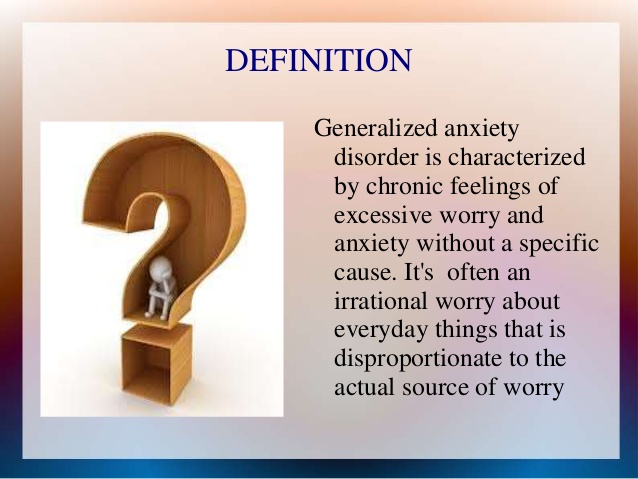
The first thing that we’re going to do is define the diagnosis of an anxiety disorder.

generalized-anxiety-disorder-3-638

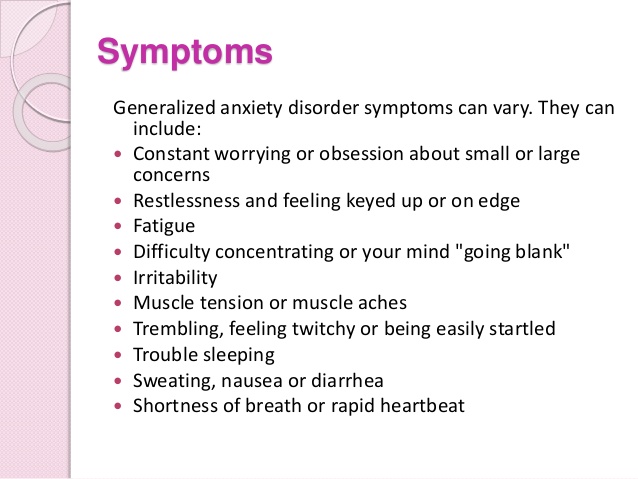
Next, let’s take a look at some of the symptoms.  When doing so, please remember that the symptoms are not always limited to this list.

anxiety-disorders-6-638

So, on a more personal level, let me tell you about my symptoms.  I can relate to the constant worrying or obsession about small or large concerns.  These are mostly caused by my mind-reading and other unhelpful thought patterns that we’ve previously discussed.  I tend to think everyone hates me or is against me.  I always assume the worst and by doing that, I think that I’m helping myself when in reality, I’m only hurting myself.  I am constantly in a state of somewhere between asleep and awake, as I suffer from sleep problems.  I’ve had my medications changed on me four times within the last two months and I can tell you, I wish they could find something that works.  I wake up on average, every three hours while sleeping.  And this is after I’ve had trouble falling asleep to begin with.  If I become highly tired, I also become very irritable.  Irritability is also caused by taking on too much at one time and overwhelming myself.  I’m absolutely no stranger to it.  Due to the amount of stress that I place on myself, I do become physically tense and experience a lot of back and shoulder pain.  It’s not a pleasant experience at all.  When it’s at it’s worst, I shake a little bit because I’m very afraid of what’s coming next.  Even if I have no reason to be, I am very afraid.  I often sweat a lot in states of extreme nervousness and if I can’t resolve the issue quickly, I become angry with myself and begin to feel sick to my stomach.  The physical ailments aligned with anxiety are more than you could ever possibly imagine.  It’s not until I’m having panic attacks, that the shortness of breath, tight chest, throat closing and rapid heartbeat start to occur.

All of that probably sounds like I’m exaggerating.  But, sadly I’m not.  I wish I were.  And that’s not even the complete list of my symptoms.

So, next comes the panic attack for me.  I’m going to take this time to define that for you.

anxiety-panic-attacks

These are NOT fun.  And I do not wish them upon anyone.  I often lose my balance, find myself swaying, feeling as though my throat is closing along with chest pain and hot flashes.  Palpitations, Sweating, and Trembling go right along with those things.  It’s exhausting having a panic attack.  And you can never really tell when they will hit.  There are a few obvious triggers for me personally, but I could be out shopping or be faced with having to make a decision and suddenly it hits.

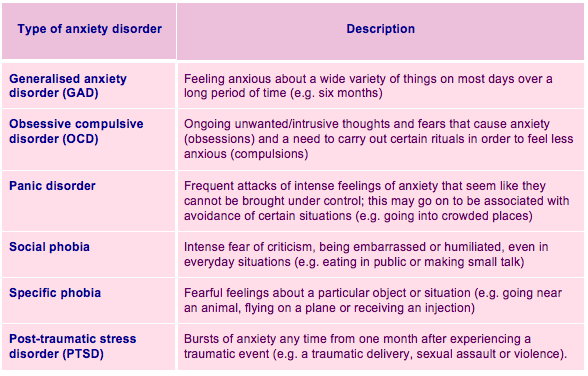
So, along with symptoms, come a list of disorders or other common ailments.

screenshot-2014-02-16-10-04-17

So, the disorders above are very specific in what they are attributed to.  If you want to know which ones I relate most to, they are: PTSD, Social Phobia (Social Anxiety), Panic Disorder and Generalized Anxiety.

PTSD we will talk about in another Diagnosis Section of my blog.

As far as Social Anxiety goes, it’s the worst.  I always think people are super critical of me and worry about what they will think or how they will judge me.  I feel super awkward trying to start and maintain a conversation, like I’m just waiting to say that one weird thing or embarrassing myself in the process.  So, I end up isolating myself, to avoid the fear and anxiety of it.  This is something that I’m now working on doing better at.  I’ve been knocking on my social phobia’s door and saying hello more frequently.  But, it’s difficult to want to do it.

Oh my, Panic Disorder.  I can relate to what the definition says about avoiding certain situations, places and things.  I dislike crowds very much, I feel like I can’t move in them.  It’s like I’m being squeezed very tightly by a bunch of pressure that is made up of the people surrounding me.  So I avoid anything that puts me into that situation.  I will panic.  I have to sit on the end row in the movie theaters and I must know where the nearest restroom is.  Maybe that’s weird to you, but knowing how my body functions sometimes, I just feel it’s for the best.  And I don’t want to have to crawl out over people if I need to leave suddenly.

General Anxiety (GAD) I feel is what most people relate to.  But, I feel as though I take it to the extreme.  I worry and then I worry some more, about anything and everything…even if I have to actually actively find something to worry about.  I will worry.  Whether it’s about finances, relationships, what people think or feel about me, or even whether I’m questioning myself.  It’s at times so overwhelming and hard to contain.  But, I guess that’s why I’m on the meds that I’m currently on.

Some days, I feel as though I can’t even get out of bed, the feelings are just too much for me to want to face.  It’s scary.  It’s the abundance of this along with my depression that made me do what I did to myself whenever it got to be too much.

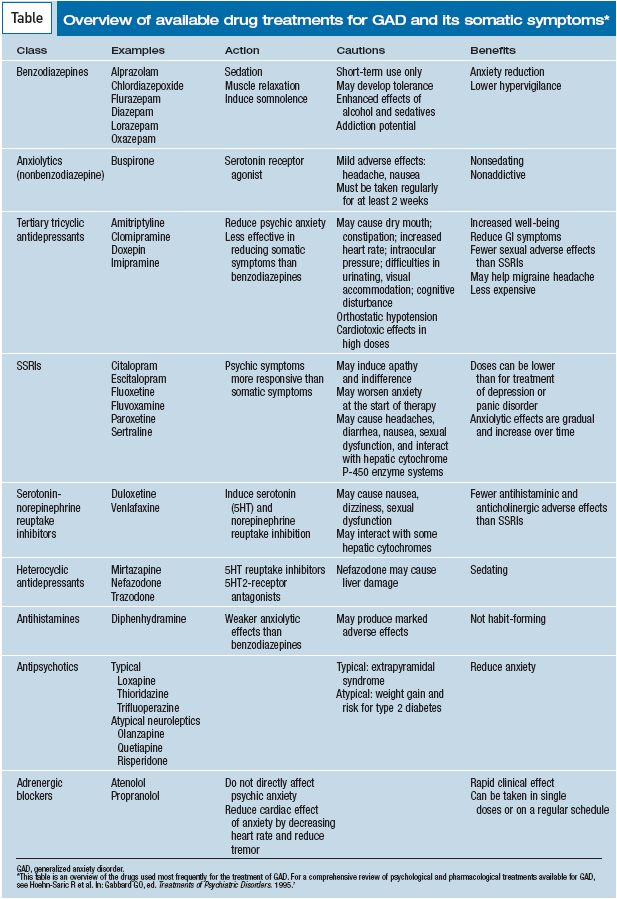
This brings me to medications.  I’m sure many of you are as familiar with these as I am.

0703pthoehn-sarict

Since my anxiety diagnosis, I have seen a lot of medications come and go.  From this list alone, I’ve been on: Mirtazapine, Trazodone, Venlafaxine, Fluoxetine, Citalopram, Buspirone, and maybe a couple more that I’ve forgotten by now.  And maybe a few that aren’t even listed.  I know for certain I don’t see Klonopin or Effexor up there, but I’ve been on those as well.  They may be more for depression though, we’ll find out later.

Some other natural things that I do in order to keep my anxiety in check are to clean, declutter and organize my house.  And since I’ve figured out that the Lavender scent is supposed to help, I have gone way overboard with that.  I used to drink chamomile and/or sleepy time teas.  But, I haven’t done that in quite a while now.  I think I found it relaxing, for what that’s worth.  And then there’s the giant elephant in the room….exercise.  Who wants to do that?!  But, sometimes, there is no better cure for what ails me than to drag my butt outside or even just out of bed and get to work on something constructive.

There will always be this war inside of my head.  But, at least I’m fighting and not giving in.

This too, shall pass.

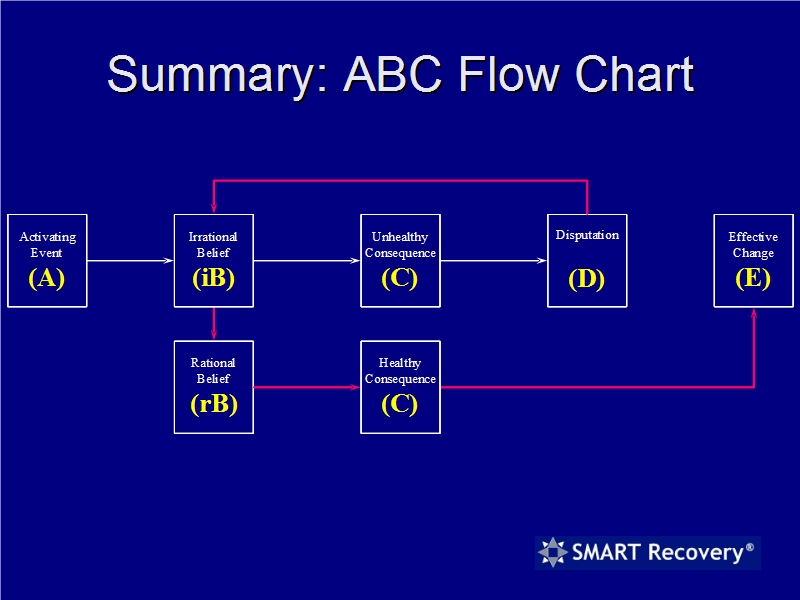
A B C Theory of Emotional Disturbance

Facts are not Feelings.

ABC Theory of Emotional Disturbance: “It is not the event, but rather our interpretation of it, that causes our emotional reaction.”

A-the trigger or stressor (ie a break up)

B-the belief and/or self-talk (ie mind-reading or catastrophizing)

C-the Emotional Consequence (ie depression)

D-the Debate of Crazy Thinking (ie talk with self or others to challenge one’s self)

E-the Emotional Effect (ie rational thoughts were met and a finalized feeling)

img18

I have had a lot of success with identifying my trigger and then asking myself rationally, “what can I do to elimate such and such?”  It’s reduced my anxiety and stress tremendously.  So, I urge you to take the ABC Theory and apply it to your life as much as possible.

Here, I will give an example of the ABC Theory in action:

A-Activating Event- Your girl friend breaks the news that she is going out with another guy, and therefore wishes to break up your relationship.

B-Beliefs/Self Talk-You begin to think things such as “I really must be a worthless person”, “I will never find a great woman like her”, She doesn’t want me; therefore no one could possibly want me” and/or “this is so awful!  Everything happens to me!”, “I can’t stand the world being so unfair.”

C-Emotional Consequences-You begin to fall into depression and/or Isolate yourself.

D-Debate of Crazy Thinking-“Where is the proof that because this girl wishes to end our relationship that I am a worthless person?  Or that I’ll never have a good relationship with someone else?  Or that I couldn’t possibly be happy alone?” and/or “Why is it awful that I am not getting what I want?”, “Why shouldn’t the world be full of injustices?”

E-Emotional Effect-Sadness (“Well, we did have a nice time and I’m sorry it didn’t work out–but we did have some problems and now I can find a new friend.” or Annoyance (“It’s annoying that she was seeing someone else but it isn’t awful or intolerable.”)

I think you have a better picture of where this is going now.  Follow the rB (Rational Belief) path and things will go so much better for you.  But, if you can not do it right away, you can go in circles with yourself until you become more rational in your way of thinking.  This is just one more thing that takes plenty of practice.

I get stuck in negativity a lot.  Lately, I’ve had to talk myself out of it and I’m finding it easier and easier to do each time.  Especially since I’ve identified a few things that trigger me.  I can avoid or deal with those things proactively and begin my self-improvement process.

Let’s Talk About Self-Esteem

I wanted to take a moment to talk about self-esteem because I have virtually none and I really need to reinforce this lesson, for myself.  And if it helps you, too, that would be terrific!

“Do not fall into the trap of believing that you are back to square one, most people have bad days – it’s called being human.”

Go ahead and think that one over.  I know I have to, several times.  In essence, it simply means that the bad days will come and maybe you even become temporarily derailed from your track of progress.  But you shouldn’t lose track of your personal growth goal when they do come – and they WILL come (you’ve heard me say this many times – it’s difficult for me to swallow at times).  Just remember don’t beat yourself up over it.  And when you can calm yourself and get your thoughts together to make a rational decision, pick up where you left off…even take a step backwards and look at how you can move forward from that point, if you have to.  It can be done!  I promise you.

Also remember this: “When writing the story of your life, don’t let anyone else hold the pen”.  Your story is your own, you can begin a new chapter for yourself any time you so choose to do so.  Just make sure that you are the one making the decisions and directing your life path.  Don’t let anyone else have so much control over you and your life that they are essentially writing your story.  No!  This is YOUR story…YOU make it happen.  Hold that pen tightly and don’t let go of it.

If someone is a constant source of negativity, no matter how much you love them or care for them, let them go.  It’s something you have to decide to do.  But, what are they contributing to you from the relationship other than sadness, self-doubt, hurt feelings and possibly a lower self-image.  I’ve been there, mostly in my past.  If they are only memories that hold you back, choose to forgive or forget.  Make the choice to not let that memory control who you want to be today.  It’s a toughy.  But if you’re ready, you’ll know that it’s an easy choice to make.

Here are a few tips for building Self-Esteem:

  • Do not set yourself up for relapse.
  • Do not put too much on your plate, too soon.  That’s pretty much a set up.
  • Put yourself into situations where the probability of success is higher.

They sound easy enough, right?  I believe that you and I can achieve them easily once our minds are clearly made up with the conscious decision to think and feel better in our own skin.

Some strategies for Building Self-Esteem

Crises of self-esteem are a part of the “human experience”.  When you feel troubled by low self-esteem, review the suggestions below and choose those that are relevant to YOUR personal situation and work on them.  Be patient with yourself, okay?  Change takes time and hard, consistent work.

  1. Free yourself from “should haves”.  Live your life on the basis of what is possible for you and what feels right to you instead of what you or others think/feel you “SHOULD DO”.  “Should haves” distract us from identifying and fulfilling our own needs, abilities, interests, and personal goals.  This leaves us with unmet needs.  And no one wants to deal with those.  Find out what you want and what you are good at.  Value those and take actions designed to fulfill your positive potential.
  2. Respect your own needs.  Recognize and take care of your own needs and wants first!  Identify what really fulfills you –not just immediate gratifications.  Respecting your deeper needs will increase your sense of worth and well-being.
  3. Set achievable goals.  Establish goals on the basis of what you can realistically achieve, then work step-by-step to develop your potential.  To strive always for perfectionism in your goals invites stress and failure.  That is the opposite of what we want.  An example of this is when you’re in school and you tell yourself that “anything but an A in school is always unacceptable.”  Don’t do this to yourself.  You’re better than that and we both know it.
  4. Talk to yourself POSITIVELY.  Stop listening to your anxiety or your “cruel inner critic”.  When you notice that you are doubting or judging yourself, replace such thoughts with self-accepting thoughts, balanced self-assessment and self-supportive directions.

    This is the hardest one for me to do, honestly.  My anxiety typically gets the best of me.  But, after I step through the doorway of my fear, I find that things aren’t nearly as bad as I expected them to be.  I listened to the devil on my shoulder, rather than my self-loving angel.  Big mistake.  I encourage you, don’t fall for what your anxiety is telling you.  It will only bring you pain.  And that’s what we’re trying to avoid here.

  5. Test your reality.  Separate your emotional reactions, such as fear and bad feelings, from the reality of your current situation.  For example, you may feel stupid, anxious, or hopeless about a project or event.  But if you think about it clearly, you may still have the ability and opportunity to accomplish something in it.
  6. Experience success.  Seek out and put yourself into situations in which the probability of success is high.  Look for projects which stretch, but do not overwhelm, your abilities.  Imagine yourself succeeding.  Whatever you may accomplish, let yourself acknowledge and experience your success and good feelings about it.  Bask in your progress and keep at it!
  7. Take chances.  New experiences are learning experiences which can build self-confidence.  Expect to make mistakes as part of the process; don’t be disappointed if you don’t do it perfectly.  Feel good about trying something new, making progress and increasing your competence.  When you practice this one, remember “Practice Makes Perfect”.  If you fall off of your bike, get right back on that baby and pedal away.  Before long, you’ll be able to ride that bike with no hands!  ha-ha.
  8. Solve problems.  Do not avoid problems, and do not moil about them.  Face them, head on!  Identify ways to solve them or to cope with them.  If you run away from problems that you can and should solve, you threaten your self-confidence.
  9. Make decisions.  Practice making and implementing positive decisions flexibly, but firmly.  Trust yourself to deal with the consequences.  When you assert yourself, you enhance your sense of yourself, learn more, and increase your self-confidence.  Just remember that YOU need to be in control of the decision making and that it should positively affect you in some way.  These decisions can start out small and grow larger as you practice the skill.  Remember the quote about holding the pen to the story of your life.  That will come in useful here.
  10. Develop your skills.  Know what you can and can not do.  Assess the skills you need; learn and practice those.  For example, if you want to start painting pictures or taking photographs.  You will need to identify the steps in doing either of those.  Then you pick up the brush and/or the camera and you start practicing.  Maybe you ask someone to model for you to begin your portfolio.  Maybe your first painting is something that you needed to copy in your own style.  Either way…..the steps are there and you know your own limits.
  11. Emphasize your strengths.  Focus on what you can do rather than what you can not.  Accept current limitations and live comfortably within them.  Even as you consider what your actual strengths are, what you might want or need to develop next.  There are only limits that you set on yourself that are in  your way.  You can learn to push the boundaries, without overdoing it.  Just focus on what you’re good at and what you know you’re capable of and the rest will fall into place.
  12. Rely on your own opinion of yourself.  Entertain feedback from others, but do not rely on their opinions.  Remember that opinions are NOT facts; therefore, they may be made up or fictional.  When you rely on someone’s opinion, it may actually be self-defeating.  So, don’t do that!  Instead, depend on your own values in making decisions and deciding how you feel about yourself and what is right for you to do.  This is your life — do what you want and be happy with it.  Be prepared to face the consequences either way.  Because following your heart, values and own decisions leaves only you accountable.  So, make them count!

Always remember to debate and replace your negative thoughts.  You can not let people steal your joy.  If it’s something that you want to work with and move forward with, don’t give others the power to take that away from you.

I say that, but I am one of the most guilty when it comes to letting others opinions, along with listening to my own thoughts and what my own fears and anxiety tell me.  I let those things hurt me, drag me down and just make myself so much more fearful than anyone should be.  That’s why I’m sharing these things with you now.  We’re stronger than we know.  And it’s time to let go of all of the negativity.  If we can make decisions that we feel good about and that make us happy–then our own consequences are the only things we have left to worry about.  If someone else doesn’t like it.  They don’t have to.  As long as what we’re doing makes us happy, screw them.  Their opinions are not factual and mean nothing in our lives unless we give them the power to.  Shut that power down.

Ch-Ch-Ch-Changes

During my two week stay at the Hospital, one of the group sessions was about making a change in your life.  And let’s be honest…I could make some good changes to my mindset and life.  So with my happiness as a goal, I was very attentive to the instructor and ready to fill out my Change Plan Worksheet Outline.

If you want to follow along with me, here is a copy of the Change Plan Worksheet.  You can print this out or review it to decide what kind of changes may fit your personal goals and growth towards a happier you.

Here, is where I’m going to go step-by-step through my own.  This will not only give you an example, but will also show you that even small changes can make a big difference.  And the more small changes that you make, the bigger the change is to the larger picture.  I hope you understand where I’m coming from.  If not, feel free to leave me questions in the comments section below.

  • The changes I want to make are:  to set up personal boundaries for myself and to not be so hard on myself or take on the worries of the world.
    • List specific areas or ways in which you want to change: I need to say “NO” more often and realize that it’s not selfish to take care of myself; not faulting myself.
    • Include positive goals (beginning, increasing, improving behaviors): increasing my personal levels of happiness and positivity.  Increasing the number of thoughts that I “challenge”.
  • The most important reasons why I want to make these changes are: to be a happier & healthier version of myself.  Because my life depends on it.
    • What are some likely consequences of action and inaction: I could end up with a different outlook on life and a more positive mindset.  The other consequence could be a life full of unhappiness and anger; leading to the possibilities of suicide.
    • Which motivations for change seem most important to you?  My ultimate happiness and quality of life need to be improved.
  • The steps I plan to take in changes are:  to take baby steps and to worry less about what people think of what my choices are or what I’m doing.
    • How do you plan to achieve the goals?  By first achieving smaller goals that will accumulate to change the bigger picture in my life.
    • Within the general plan, what are some specific first steps you might take?  Setting healthy and clear boundaries for myself; begin cultivating the life that I want to lead and making the changes that I think are in my best interest.
    • When, where and how will these steps be taken?  They will begin with today, it will take a lot of emotional and mental energy.  So, I plan to take them on one by one…individually, so that I do not add to my anxiety and/or become overwhelmed.
  • The ways other people can help me are:  Others can hold me accountable for the goals that I’ve made clear to them.
    • List specific ways that others can help support you in your change attempt: Supporting my decisions and doing what they can to ensure that I follow through with my goals.
    • How will you go about eliciting others’ support?  I plan on stating my goals clearly to a hand full of people.  Then, it will be important for me to acknowledge issues as they arise and getting their help with challenging the unhelpful thought or in eliminating my discouragement.
  • I will know that my plan is working if:  I am meeting my short-term, smaller goals to achieve progress towards a larger outcome.
    • What do you hope will happen as a result of the change?  I hope that I can find hope, peace, personal happiness and the light that I know can shine out of me.
    • What benefits can you expect form the change?  A more consistent and positive mindset.  Hopefully to feel more at ease within my own skin, more confident, and less worrisome with whatever anyone else thinks or with burdens that are not my own to carry.
  • Some things that could interfere with my plans are:  Relapse, not following through, people in general with their negative thoughts and attitudes that will only bring me down.
    • Anticipate situations or changes that could undermine the plan:  There are situations where someone may disagree with what I say I need for myself.  There are people who may question whether or not I am competent.  There will always be someone that is just sitting on that back burner waiting for me to fail – and they would absolutely love it.
      • What could go wrong?  I could not achieve goals that I have set for myself or an event or person could interfere with my progress, only holding me back.
      • How might you stick with the plan despite the changes and/or setbacks?  I will challenge myself by attempting to change my own perspective.  I will be more flexible and if I cannot achieve one goal, I will substitute it by completing another.  I will realize that other people are not living my life and that there are always ways to go around or over each obstacle put in my path.

My personal goals may be humorous to you.  But, they are mine.  You get to decide what kind of goals to make for yourself and ONLY yourself.  You cannot depend on anyone else to make the desired changes to your life for you.  That’s unreasonable and impossible.  And you can’t do nothing and expect things to end up differently.  This is a decision that you have to make for yourself.  And that you will have to follow through with, for yourself.  You can ask for help from others, by asking to be held accountable for your desired changes.  But, after that….it’s all up to you.  By being held accountable, it’s asking for support – but that person isn’t going to force you to make the change that you already said you wanted.  And when you get discouraged, keep looking at the horizon.  It’s in front of you, not behind you.  Don’t be afraid of making smaller goals or changes.  Because after completing a couple of those, you’ll be headed in the right direction!

I wish you luck and am sending my support.  You now know a portion of the goals I’ve set out to achieve through intensive group therapy.  I plan to continue sharing….

Here are two more handouts that you may find helpful in this process.  I encourage you to at least read them over and think about them for a while:

Part 1 – Challenging My Unhelpful Idea

Part 2- Recognizing Discouragement, Out-thinking Discouragement, Seeking Out Encouragement, & Courage/Inner Strength Building Plan