
A B C Theory of Emotional Disturbance

Facts are not Feelings.

ABC Theory of Emotional Disturbance: “It is not the event, but rather our interpretation of it, that causes our emotional reaction.”

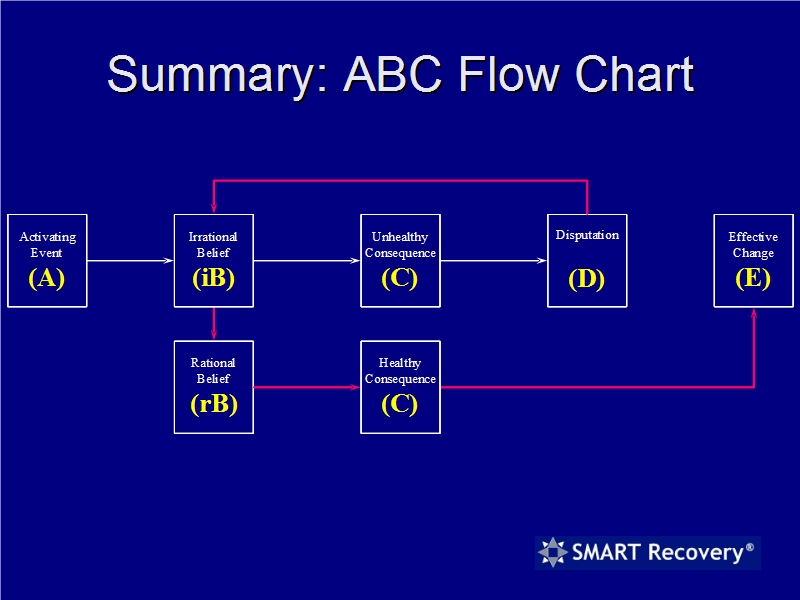
A-the trigger or stressor (ie a break up)

B-the belief and/or self-talk (ie mind-reading or catastrophizing)

C-the Emotional Consequence (ie depression)

D-the Debate of Crazy Thinking (ie talk with self or others to challenge one’s self)

E-the Emotional Effect (ie rational thoughts were met and a finalized feeling)
img18

I have had a lot of success with identifying my trigger and then asking myself rationally, “what can I do to elimate such and such?”  It’s reduced my anxiety and stress tremendously.  So, I urge you to take the ABC Theory and apply it to your life as much as possible.

Here, I will give an example of the ABC Theory in action:

A-Activating Event- Your girl friend breaks the news that she is going out with another guy, and therefore wishes to break up your relationship.

B-Beliefs/Self Talk-You begin to think things such as “I really must be a worthless person”, “I will never find a great woman like her”, She doesn’t want me; therefore no one could possibly want me” and/or “this is so awful!  Everything happens to me!”, “I can’t stand the world being so unfair.”

C-Emotional Consequences-You begin to fall into depression and/or Isolate yourself.

D-Debate of Crazy Thinking-“Where is the proof that because this girl wishes to end our relationship that I am a worthless person?  Or that I’ll never have a good relationship with someone else?  Or that I couldn’t possibly be happy alone?” and/or “Why is it awful that I am not getting what I want?”, “Why shouldn’t the world be full of injustices?”

E-Emotional Effect-Sadness (“Well, we did have a nice time and I’m sorry it didn’t work out–but we did have some problems and now I can find a new friend.” or Annoyance (“It’s annoying that she was seeing someone else but it isn’t awful or intolerable.”)

I think you have a better picture of where this is going now.  Follow the rB (Rational Belief) path and things will go so much better for you.  But, if you can not do it right away, you can go in circles with yourself until you become more rational in your way of thinking.  This is just one more thing that takes plenty of practice.

I get stuck in negativity a lot.  Lately, I’ve had to talk myself out of it and I’m finding it easier and easier to do each time.  Especially since I’ve identified a few things that trigger me.  I can avoid or deal with those things proactively and begin my self-improvement process.

Got ANTs?

“It’s not who you are that holds you back; it’s who you think you’re not.” – Unknown

Thoughts are underrated in their ability to control our moods and emotions.  Just a simple thought can bring your happiest day crashing in an unstoppable downward spiral.  And the more we feed such thoughts, the heavier they will weigh upon us.

If you have never stopped to think about that before, just take a minute now to do so…I’ll wait…

Got it?  I never spent much time thinking about it until we covered the lesson in one of my group sessions at the Hospital.  But, it’s absolutely true!  And the good news is, there is plenty that we can do about it.

First of all, I’d like to explain the title.  As we learned it in the session, ANTs is an acronym for Automatic Negative Thoughts.  I found it kind of cute and I liked the way it was presented as that concept.  So, that’s the way I’m going to relay it to you.  And if you think this lesson isn’t important…well, that’s on you.  But, I’d encourage you to give it a chance, as some of the information I found to be very helpful.

Sometimes when ANTs occur, I find myself reacting to them negatively.  I may be distressed, angry or even worried about what I am thinking to be the truth.  But, the first thing I need to do is to stop and identify that thought-you know the one, the one that has you all riled up and in a tizzy.  Yes, that one!

Once I’ve done that, it’s time to stop it; the cycle of the thought running through my head and the little voice questioning it maliciously.  Take a breath, get some air…it’s now that I want and need to calm myself down.  It’s important that I’m calm first, as physiologically, when I’m tense, I’m not thinking rationally.  I’m so focused on the negative thought and feelings associated with that.  By calming oneself, it allows for more oxygen to get to the brain and form more rational thoughts.  It’s then that I’ll take a closer look at the thought that has us in such an uproar.  I’m saying ‘us’, because we ALL do this.  It isn’t just you or me.  It’s human, but there are ways to be smarter about it.

What I’m working on with this, is Cognitive Restructuring or Cognitive Behavior Therapy (CBT).  Simplifying it, it means to re-build thoughts.  And by doing that, I can challenge my ANTs.

When I get ready to challenge my negative thought, it’s important that I ask myself some questions.  The reason this is important is so that I can evaluate how truly important to me the thought is, if I might be overreacting to something, or if things just might not be as bad as they seem to me at the time.

Here is an example of the questions that I might go through.  And for humor’s sake…refer to the list of questions as ANT spray.

Another form of ANT spray (I can’t even type that without smiling), is for me to decide if the thought may be something that I’m super sensitive to.  Personally, I’m super sensitive to social situations and my self-image.  Which means my thought process will always be searching for for a reason to be critical of myself.  One of my counselors called this super sensitivity a Super Scanner.  And I found myself relating to being overly sensitive when it comes to certain things in my head.

Most of the time, after asking myself some of those questions, I realize that the problem is not as large as I’m making it in my head.  Sometimes, I even come to the conclusion that it doesn’t matter to me nearly as much as I initially felt it did – or get this, that it just might not be my problem to worry about in the first place.

It’s going to take a lot of practice on my part.  But, I have confidence that I can begin to train my mind to listen to a more rational me in time.  Practice makes perfect, after all!