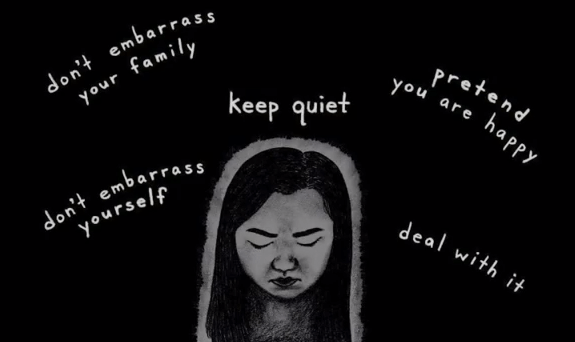
So, what does the topic of this blog mean? Simply put, when you let the negative thoughts into your head without challenging them, the result is that you then cause yourself negative feelings.

Maybe you’ve seen things posted as trigger warnings. Do you know what this means?
noun. 1. a stated warning that the content of a text, video, etc., may upset or offend some people, especially those who have previously experienced a related trauma: a blog post with a trigger warning for rape.
Triggers can be thoughts, places, things, people, feelings…work, school, new places…anxiety, stress, worry…money, crowds, being bullied…mainly anything that can lead us to a negative thought, reaction or feeling. It’s very common amongst PTSD, anxiety and trauma survivors.
We used to believe that it was depression or anxiety that made people think negatively, but psychologists and psychiatrists have discovered that most people who struggle with anxious or depressed feelings first had negative, pessimistic, distorted thoughts that produced those feelings.
People often have completely different perspectives and reactions to the same situations. For example, John and Jack both heard their Supervisor say to their Production Group, “We have to work harder and be more productive. Too much time is being wasted on trivial matters and we need to get focused.” John might think “The Supervisor is trying to increase production and make us more efficient. I’d better do my part.” But Jack may be thinking “The Supervisor is blaming me for our low productivity. I am worried that I am going to get fired. He never did like me.” Jack returns to work feeling depressed and anxious and his preoccupation with these negative thoughts reduce his productivity. On the other hand , John returns to work more focused and confident that the situation can improve.
They both experienced the same situation and came to very different thought processes and reacted differently. That’s so interesting to me. But, very real.
The thoughts and interpretations that you make regarding a circumstance have a very strong influence on the feelings that are generated. Psychologists have identified several negative thinking patterns that are common to people who struggle with feelings of anxiety and depression. These distorted thinking patterns can then trigger the negative feelings and can lead to chronic states of depression and anxiety.
This totally applies to my life. I’m probably more guilty of being like Jack than like John. However, I’ve made recent decisions to work on being more like John. And it will take time and practice, but I’m confident in my ability to start over. A new chapter, as I put it. A nice blank slate for me to re-start and re-train myself and where I can continuously grow. Not being too hard on myself for stumbling here or there, but knowing that I am headed in the right direction!
Here are some types of distorted thinking. You may find yourself identifying with some or all of them. I will tell you right now that I have a hard time with the following: Black or white, Exaggerating, Judging, Mind Reading, Forecasting, and Self-Blaming. You’ll see what I mean in the below ideas.
Black or White-Viewing situations, people, or self as entirely bad or entirely good – nothing in between.
Example: When Mary brought her vegetable salad to a neighborhood potluck, a hostess commented, “That’s our third salad.” Mary immediately thought “She’s criticizing me. She doesn’t like me.”
Exaggerating-Making self-critical or other-critical statements that include terms like never, nothing, everything, or always.
Example: Jack was accidentally overlooked when coworkers joined to make plans for lunch together. Jack thought, “They never ask me to do anything. Nobody wants me around here.”
Filtering-Ignoring the positive things that occur to and around self but focusing on and accentuating the negative.
Example: Kate had her hair cut short and styled differently. After receiving many compliments from friends and family, one person was mildly critical. Kate thought “I knew I shouldn’t have gotten it cut short. I look like a freak. People are laughing at me.”
Discounting-Rejecting positive experiences as not being important or meaningful.
Example: Tyler was complimented by his boss for his good work on a project. He thought, “Anybody could have done that. She doesn’t know anything about this project and I didn’t do anything special with it.”
Catastrophizing-Blowing expected consequences out of proportion in a negative manner.
Example: The teacher told Mary that her son was struggling a bit with math. Mary thought, “This is awful. Johnny is going to fail. I knew I should have worked with him more.”
Judging-Being critical of self or others with a heavy emphasis on the use of should have, ought to, must, have to, and should not have.
Example: Jill made a sales presentation to a client. The client was very attentive and made comments about being impressed with the product. Jill thought, “He knows I stumbled over my words. I should have been more prepared. I have to be more relaxed or no client will ever buy from me.”
Mind Reading (Fortune Telling)-Making negative assumptions regarding other people’s thoughts and motives.
Example: Aaron inquired about a transfer to a new department. When he was told the position was already filled, he thought, “This manager never did like me. He knew I wanted that position but he just ignored me.”
Forecasting (Comparing experience to prior experiences that could lead to a self-fulfilling prophecy)-Predicting events will turn out badly.
Example: Kelly just finished an important job interview. She immediately predicted that she would not get hired. “I’ll never get this job. That interview was awful and I am sure that I blew it,” she thought.
Feelings are Facts-Because you feel a certain way, reality is seen as fitting that feeling.
Example: Jim didn’t have plans for activity with any friends for the weekend. He felt lonely and inferior. He thought, “No one likes me. I have a terrible personality.”
Labeling-Calling self or others a bad name when displeased with a behavior.
Example: Joan had a disagreement with her friend about where to meet for lunch. Joan thought, “Betty is such a controller. She never listens to anyone and insists on always getting her own way.”
Self-Blaming-Holiding self responsible for an outcome that was not completely under one’s control. (This is totally ME!)
Example: Paula’s friend had a minor traffic accident while she and Paula were riding to the mall. Paula thought, “This accident was all my fault. I should not have been talking to Jackie while we were driving. Even though that other car hit us, I am sure Jackie could have avoided it if I would have kept my mouth shut.”.
I have been over this in my group session and that’s why I can tell you which ones suit my personality and my thought process. None of these are really good ways at looking at things, so we should all be held responsible for changing our perspectives and for stopping the assumptions. Easier said than done, but again…baby steps. Walk with me. Very slowly. And every time our voice in our head is telling us to react to something in a negative manner, be sure to question that thought. Argue with it inside your head if you have to. I do! And man, it’s exhausting. But, the war can never be won if it’s never fought.
Apply these 11 common types of distorted thinking to your own way of thinking. List at least three examples of your own thoughts that lead you to feeling depressed and anxious. First describe the event that prompted you to feel depressed and then describe the thoughts that promoted the bad feelings.
This is where I highly recommend journals or writing things down, so that you can review them later and recognize what happened. This way, you can eventually discover patterns and thought processes that need to be changed or worked on. If we can stop the negative thoughts from triggering us, then maybe we can stop the negative feelings, too.
What do you think?

 bemindful.health.blog