Diagnosis: Anxiety

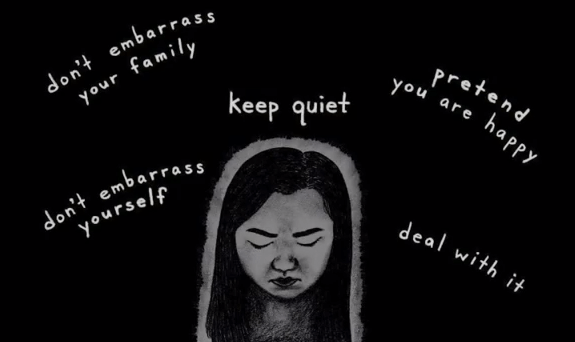
I figured that today was a good day to start talking about my personal Diagnosis.  Though, I will be breaking them down in to single categories, in full I am diagnosed with C-PTSD, Anxiety Disorder and Clinical Depression.

Today, we’ll talk about anxiety on a personal level.  How it has affected me personally and how I’ve felt about it, etc.

The first thing that we’re going to do is define the diagnosis of an anxiety disorder.
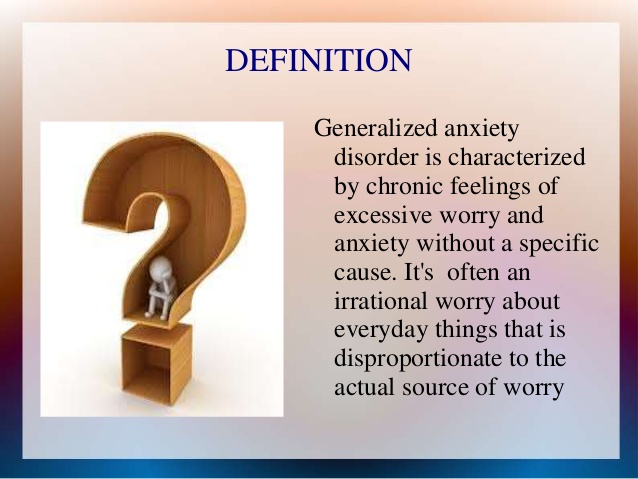
generalized-anxiety-disorder-3-638

Next, let’s take a look at some of the symptoms.  When doing so, please remember that the symptoms are not always limited to this list.
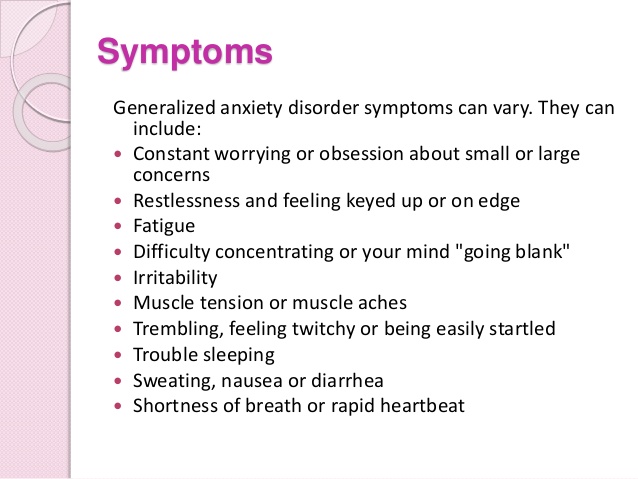
anxiety-disorders-6-638

So, on a more personal level, let me tell you about my symptoms.  I can relate to the constant worrying or obsession about small or large concerns.  These are mostly caused by my mind-reading and other unhelpful thought patterns that we’ve previously discussed.  I tend to think everyone hates me or is against me.  I always assume the worst and by doing that, I think that I’m helping myself when in reality, I’m only hurting myself.  I am constantly in a state of somewhere between asleep and awake, as I suffer from sleep problems.  I’ve had my medications changed on me four times within the last two months and I can tell you, I wish they could find something that works.  I wake up on average, every three hours while sleeping.  And this is after I’ve had trouble falling asleep to begin with.  If I become highly tired, I also become very irritable.  Irritability is also caused by taking on too much at one time and overwhelming myself.  I’m absolutely no stranger to it.  Due to the amount of stress that I place on myself, I do become physically tense and experience a lot of back and shoulder pain.  It’s not a pleasant experience at all.  When it’s at it’s worst, I shake a little bit because I’m very afraid of what’s coming next.  Even if I have no reason to be, I am very afraid.  I often sweat a lot in states of extreme nervousness and if I can’t resolve the issue quickly, I become angry with myself and begin to feel sick to my stomach.  The physical ailments aligned with anxiety are more than you could ever possibly imagine.  It’s not until I’m having panic attacks, that the shortness of breath, tight chest, throat closing and rapid heartbeat start to occur.

All of that probably sounds like I’m exaggerating.  But, sadly I’m not.  I wish I were.  And that’s not even the complete list of my symptoms.

So, next comes the panic attack for me.  I’m going to take this time to define that for you.

anxiety-panic-attacks

These are NOT fun.  And I do not wish them upon anyone.  I often lose my balance, find myself swaying, feeling as though my throat is closing along with chest pain and hot flashes.  Palpitations, Sweating, and Trembling go right along with those things.  It’s exhausting having a panic attack.  And you can never really tell when they will hit.  There are a few obvious triggers for me personally, but I could be out shopping or be faced with having to make a decision and suddenly it hits.

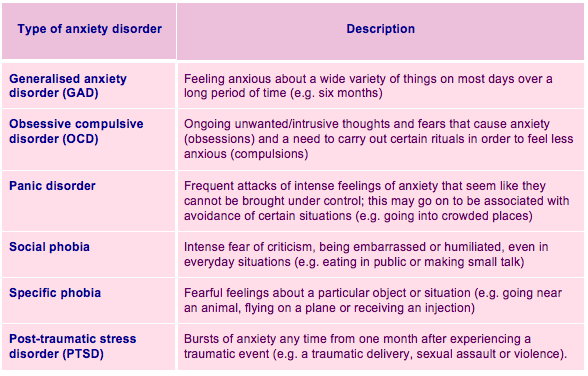
So, along with symptoms, come a list of disorders or other common ailments.
screenshot-2014-02-16-10-04-17

So, the disorders above are very specific in what they are attributed to.  If you want to know which ones I relate most to, they are: PTSD, Social Phobia (Social Anxiety), Panic Disorder and Generalized Anxiety.

PTSD we will talk about in another Diagnosis Section of my blog.

As far as Social Anxiety goes, it’s the worst.  I always think people are super critical of me and worry about what they will think or how they will judge me.  I feel super awkward trying to start and maintain a conversation, like I’m just waiting to say that one weird thing or embarrassing myself in the process.  So, I end up isolating myself, to avoid the fear and anxiety of it.  This is something that I’m now working on doing better at.  I’ve been knocking on my social phobia’s door and saying hello more frequently.  But, it’s difficult to want to do it.

Oh my, Panic Disorder.  I can relate to what the definition says about avoiding certain situations, places and things.  I dislike crowds very much, I feel like I can’t move in them.  It’s like I’m being squeezed very tightly by a bunch of pressure that is made up of the people surrounding me.  So I avoid anything that puts me into that situation.  I will panic.  I have to sit on the end row in the movie theaters and I must know where the nearest restroom is.  Maybe that’s weird to you, but knowing how my body functions sometimes, I just feel it’s for the best.  And I don’t want to have to crawl out over people if I need to leave suddenly.

General Anxiety (GAD) I feel is what most people relate to.  But, I feel as though I take it to the extreme.  I worry and then I worry some more, about anything and everything…even if I have to actually actively find something to worry about.  I will worry.  Whether it’s about finances, relationships, what people think or feel about me, or even whether I’m questioning myself.  It’s at times so overwhelming and hard to contain.  But, I guess that’s why I’m on the meds that I’m currently on.

Some days, I feel as though I can’t even get out of bed, the feelings are just too much for me to want to face.  It’s scary.  It’s the abundance of this along with my depression that made me do what I did to myself whenever it got to be too much.

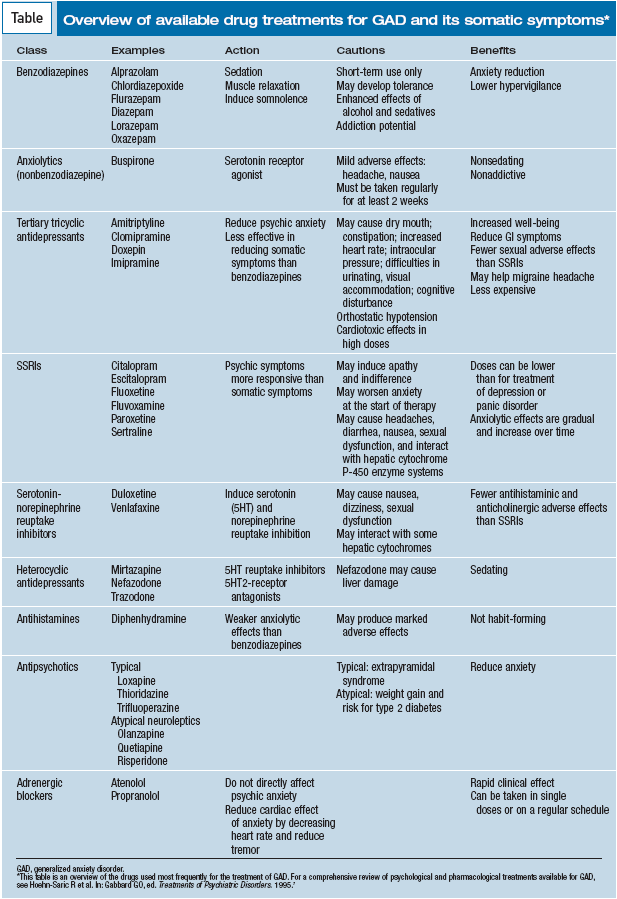
This brings me to medications.  I’m sure many of you are as familiar with these as I am.
0703pthoehn-sarict

Since my anxiety diagnosis, I have seen a lot of medications come and go.  From this list alone, I’ve been on: Mirtazapine, Trazodone, Venlafaxine, Fluoxetine, Citalopram, Buspirone, and maybe a couple more that I’ve forgotten by now.  And maybe a few that aren’t even listed.  I know for certain I don’t see Klonopin or Effexor up there, but I’ve been on those as well.  They may be more for depression though, we’ll find out later.

Some other natural things that I do in order to keep my anxiety in check are to clean, declutter and organize my house.  And since I’ve figured out that the Lavender scent is supposed to help, I have gone way overboard with that.  I used to drink chamomile and/or sleepy time teas.  But, I haven’t done that in quite a while now.  I think I found it relaxing, for what that’s worth.  And then there’s the giant elephant in the room….exercise.  Who wants to do that?!  But, sometimes, there is no better cure for what ails me than to drag my butt outside or even just out of bed and get to work on something constructive.

There will always be this war inside of my head.  But, at least I’m fighting and not giving in.

This too, shall pass.

A B C Theory of Emotional Disturbance

Facts are not Feelings.

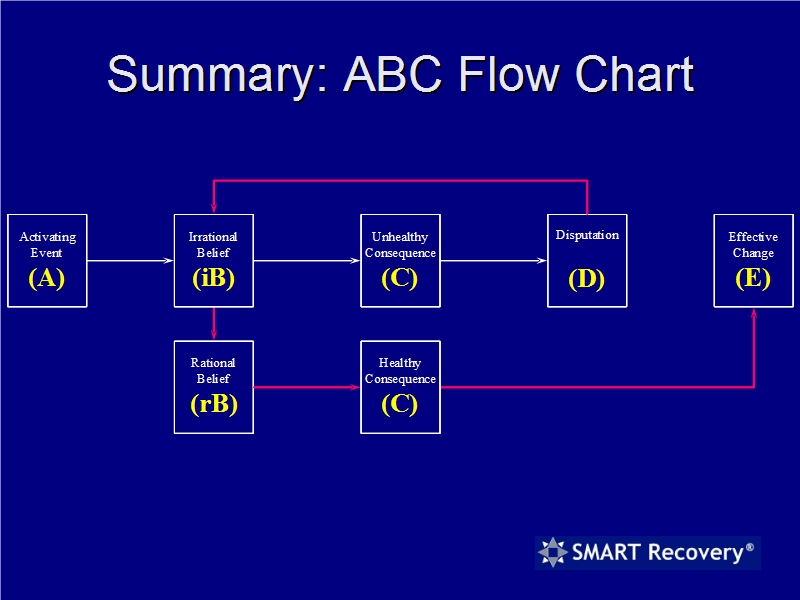
ABC Theory of Emotional Disturbance: “It is not the event, but rather our interpretation of it, that causes our emotional reaction.”

A-the trigger or stressor (ie a break up)

B-the belief and/or self-talk (ie mind-reading or catastrophizing)

C-the Emotional Consequence (ie depression)

D-the Debate of Crazy Thinking (ie talk with self or others to challenge one’s self)

E-the Emotional Effect (ie rational thoughts were met and a finalized feeling)

img18

I have had a lot of success with identifying my trigger and then asking myself rationally, “what can I do to elimate such and such?”  It’s reduced my anxiety and stress tremendously.  So, I urge you to take the ABC Theory and apply it to your life as much as possible.

Here, I will give an example of the ABC Theory in action:

A-Activating Event- Your girl friend breaks the news that she is going out with another guy, and therefore wishes to break up your relationship.

B-Beliefs/Self Talk-You begin to think things such as “I really must be a worthless person”, “I will never find a great woman like her”, She doesn’t want me; therefore no one could possibly want me” and/or “this is so awful!  Everything happens to me!”, “I can’t stand the world being so unfair.”

C-Emotional Consequences-You begin to fall into depression and/or Isolate yourself.

D-Debate of Crazy Thinking-“Where is the proof that because this girl wishes to end our relationship that I am a worthless person?  Or that I’ll never have a good relationship with someone else?  Or that I couldn’t possibly be happy alone?” and/or “Why is it awful that I am not getting what I want?”, “Why shouldn’t the world be full of injustices?”

E-Emotional Effect-Sadness (“Well, we did have a nice time and I’m sorry it didn’t work out–but we did have some problems and now I can find a new friend.” or Annoyance (“It’s annoying that she was seeing someone else but it isn’t awful or intolerable.”)

I think you have a better picture of where this is going now.  Follow the rB (Rational Belief) path and things will go so much better for you.  But, if you can not do it right away, you can go in circles with yourself until you become more rational in your way of thinking.  This is just one more thing that takes plenty of practice.

I get stuck in negativity a lot.  Lately, I’ve had to talk myself out of it and I’m finding it easier and easier to do each time.  Especially since I’ve identified a few things that trigger me.  I can avoid or deal with those things proactively and begin my self-improvement process.

Negative Thoughts Trigger Negative Feelings

So, what does the topic of this blog mean?  Simply put, when you let the negative thoughts into your head without challenging them, the result is that you then cause yourself negative feelings.

leo

Maybe you’ve seen things posted as trigger warnings.  Do you know what this means?

noun. 1. a stated warning that the content of a text, video, etc., may upset or offend some people, especially those who have previously experienced a related trauma: a blog post with a trigger warning for rape.

Triggers can be thoughts, places, things, people, feelings…work, school, new places…anxiety, stress, worry…money, crowds, being bullied…mainly anything that can lead us to a negative thought, reaction or feeling.  It’s very common amongst PTSD, anxiety and trauma survivors.

We used to believe that it was depression or anxiety that made people think negatively, but psychologists and psychiatrists have discovered that most people who struggle with anxious or depressed feelings first had negative, pessimistic, distorted thoughts that produced those feelings.

People often have completely different perspectives and reactions to the same situations.  For example, John and Jack both heard their Supervisor say to their Production Group, “We have to work harder and be more productive.  Too much time is being wasted on trivial matters and we need to get focused.”  John might think “The Supervisor is trying to increase production and make us more efficient.  I’d better do my part.”  But Jack may be thinking “The Supervisor is blaming me for our low productivity.  I am worried that I am going to get fired.  He never did like me.”  Jack returns to work feeling depressed and anxious and his preoccupation with these negative thoughts reduce his productivity.  On the other hand , John returns to work more focused and confident that the situation can improve.

They both experienced the same situation and came to very different thought processes and reacted differently.  That’s so interesting to me.  But, very real.

The thoughts and interpretations that you make regarding a circumstance have a very strong influence on the feelings that are generated.  Psychologists have identified several negative thinking patterns that are common to people who struggle with feelings of anxiety and depression.  These distorted thinking patterns can then trigger the negative feelings and can lead to chronic states of depression and anxiety.

This totally applies to my life.  I’m probably more guilty of being like Jack than like John.  However, I’ve made recent decisions to work on being more like John.  And it will take time and practice, but I’m confident in my ability to start over.  A new chapter, as I put it.  A nice blank slate for me to re-start and re-train myself and where I can continuously grow.  Not being too hard on myself for stumbling here or there, but knowing that I am headed in the right direction!

Here are some types of distorted thinking.  You may find  yourself identifying with some or all of them.  I will tell you right now that I have a hard time with the following: Black or white, Exaggerating, Judging, Mind Reading, Forecasting, and Self-Blaming.  You’ll see what I mean in the below ideas.

Black or White-Viewing situations, people, or self as entirely bad or entirely good – nothing in between.

Example: When Mary brought her vegetable salad to a neighborhood potluck, a hostess commented, “That’s our third salad.”  Mary immediately thought “She’s criticizing me.  She doesn’t like me.”

Exaggerating-Making self-critical or other-critical statements that include terms like never, nothing, everything, or always.

Example: Jack was accidentally overlooked when coworkers joined to make plans for lunch together.  Jack thought, “They never ask me to do anything.  Nobody wants me around here.”

Filtering-Ignoring the positive things that occur to and around self but focusing on and accentuating the negative.

Example: Kate had her hair cut short and styled differently.  After receiving many compliments from friends and family, one person was mildly critical.  Kate thought “I knew I shouldn’t have gotten it cut short.  I look like a freak.  People are laughing at me.”

Discounting-Rejecting positive experiences as not being important or meaningful.

Example: Tyler was complimented by his boss for his good work on a project.  He thought, “Anybody could have done that.  She doesn’t know anything about this project and I didn’t do anything special with it.”

Catastrophizing-Blowing expected consequences out of proportion in a negative manner.

Example: The teacher told Mary that her son was struggling a bit with math.  Mary thought, “This is awful.  Johnny is going to fail.  I knew I should have worked with him more.”

Judging-Being critical of self or others with a heavy emphasis on the use of should have, ought to, must, have to, and should not have.

Example: Jill made a sales presentation to a client.  The client was very attentive and made comments about being impressed with the product.  Jill thought, “He knows I stumbled over my words.  I should have been more prepared.  I have to be more relaxed or no client will ever buy from me.”

Mind Reading (Fortune Telling)-Making negative assumptions regarding other people’s thoughts and motives.

Example: Aaron inquired about a transfer to a new department.  When he was told the position was already filled, he thought, “This manager never did like me.  He knew I wanted that position but he just ignored me.”

Forecasting (Comparing experience to prior experiences that could lead to a self-fulfilling prophecy)-Predicting events will turn out badly.

Example: Kelly just finished an important job interview.  She immediately predicted that she would not get hired.  “I’ll never get this job.  That interview was awful and I am sure that I blew it,” she thought.

Feelings are Facts-Because you feel a certain way, reality is seen as fitting that feeling.

Example: Jim didn’t have plans for activity with any friends for the weekend.  He felt lonely and inferior.  He thought, “No one likes me.  I have a terrible personality.”

Labeling-Calling self or others a bad name when displeased with a behavior.

Example: Joan had a disagreement with her friend about where to meet for lunch.  Joan thought, “Betty is such a controller.  She never listens to anyone and insists on always getting her own way.”

Self-Blaming-Holiding self responsible for an outcome that was not completely under one’s control. (This is totally ME!)

Example: Paula’s friend had a minor traffic accident while she and Paula were riding to the mall.  Paula thought, “This accident was all my fault.  I should not have been talking to Jackie while we were driving.  Even though that other car hit us, I am sure Jackie could have avoided it if I would have kept my mouth shut.”.

I have been over this in my group session and that’s why I can tell you which ones suit my personality and my thought process.  None of these are really good ways at looking at things, so we should all be held responsible for changing our perspectives and for stopping the assumptions.  Easier said than done, but again…baby steps.  Walk with me.  Very slowly.  And every time our voice in our head is telling us to react to something in a negative manner, be sure to question that thought.  Argue with it inside your head if you have to.  I do!  And man, it’s exhausting.  But, the war can never be won if it’s never fought.

Apply these 11 common types of distorted thinking to your own way of thinking.  List at least three examples of your own thoughts that lead you to feeling depressed and anxious.  First describe the event that prompted you to feel depressed and then describe the thoughts that promoted the bad feelings.

This is where I highly recommend journals or writing things down, so that you can review them later and recognize what happened.  This way, you can eventually discover patterns and thought processes that need to be changed or worked on.  If we can stop the negative thoughts from triggering us, then maybe we can stop the negative feelings, too.

What do you think?